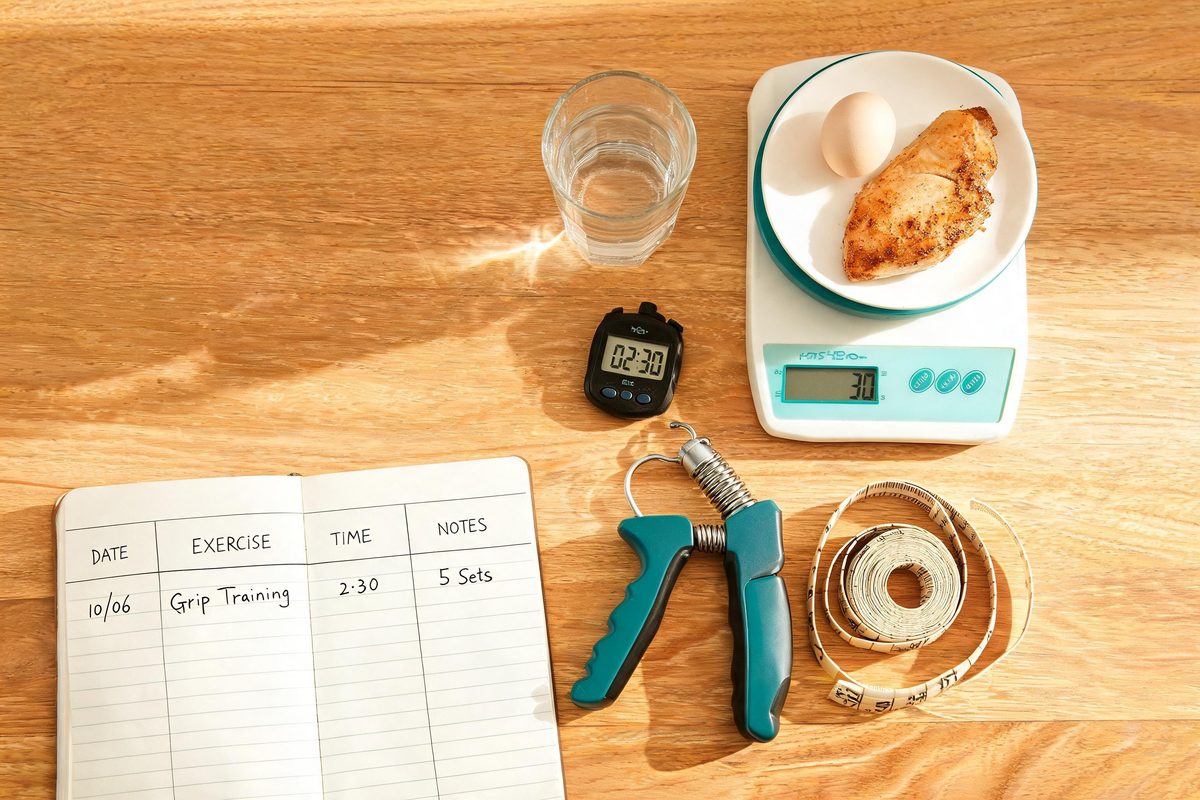
15 Practical Fitness Tips for Kidney Patients: Using RPE for Intensity, Progressive Overload, Protein Without Harming Your Kidneys, SARC-F Sarcopenia Self-Test, Warm-up & Breathing, Hydration and the Potassium in Sports Drinks
Once you know you *should* exercise, the real sticking points are how, how much, and what to eat. This article answers the 15 questions kidney patients ask most: the RPE scale, how much weight to add each week, protein targets for non-dialysis CKD / dialysis / transplant, what to eat after training, the 5-question SARC-F test, warm-up and cool-down, breathing, the potassium content of sports drinks, and which symptoms mean stop. Every tip cites its evidence.
This is the toolkit article of the Fitness for kidney patients series. Before reading, check the contraindication list in Why kidney patients should exercise and know which group you belong to — non-dialysis CKD, haemodialysis, peritoneal dialysis or transplant — because protein and fluid advice differs completely between them.
Tip 1: Use RPE, not heart rate, to set intensity
Many kidney patients take beta-blockers or have autonomic neuropathy, so heart rate is unreliable. Use the Borg RPE scale (6–20):
| RPE | Feels like | Use |
|---|---|---|
| 9–11 | Very easy, could sing | Warm-up, recovery days, early post-op |
| 12–13 | Somewhat hard but can speak full sentences | Target zone for moderate aerobic work (the WHO 150-minute intensity) |
| 14–16 | Can only speak short phrases | Hard intervals, last reps of a strength set |
| ≥17 | Cannot speak | Kidney patients generally do not need to go here |
RPE for strength: finish each set feeling you "could do 2–3 more reps" (RPE 7–8/10, or 2–3 reps in reserve) — the safest effective range (Helms 2016).
Tip 2: Progressive overload — add a little each time
Muscle and bone adapt only to "slightly more than last time". Suggested progression for kidney patients:
- Load: if you complete the target sets and reps in two consecutive sessions, add 2.5–5% (upper body) or 5–10% (lower body) next time.
- Reps: at a fixed load, build from 8 to 12 reps, then add load and drop back to 8.
- Volume: increase weekly training volume by no more than 10% to protect tendons (especially fragile on steroids) and joints.
- Deload: every 4–6 weeks, cut volume 40–50% for one week.
Tip 3: Learn 5 movement patterns before anything fancy
| Pattern | Home version | Gym version | Function protected |
|---|---|---|---|
| Squat | Sit-to-stand, wall squat | Goblet squat, leg press | Getting out of a chair, using the toilet |
| Hip hinge | Glute bridge, single-leg RDL holding a chair | Deadlift, trap-bar deadlift | Picking things up, protecting the back |
| Push | Wall push-up, band press | Bench press, shoulder press | Pushing doors, pushing up from bed |
| Pull | Band row, towel row | Seated row, lat pulldown | Posture, carrying bags |
| Loaded carry | Carry two water jugs 30 s | Farmer's walk | Grip strength (a mortality predictor in kidney disease) |
Grip strength is the cheapest health marker for kidney patients: men <28 kg, women <18 kg (AWGS 2019 Asian cut-offs) signals sarcopenia.
Tip 4: SARC-F — a 5-question sarcopenia self-test
Score each 0–2; ≥4 points → ask your doctor to assess for sarcopenia (Malmstrom 2016; recommended by AWGS 2019):
- How difficult is it to lift and carry 4.5 kg (about 5 L of water)? (None 0 / Some 1 / A lot or unable 2)
- How difficult is it to walk across a room?
- How difficult is it to get up from a chair or bed?
- How difficult is it to climb 10 stairs?
- How many times have you fallen in the past year? (0 → 0 / 1–3 → 1 / ≥4 → 2)
Tip 5: Protein — completely different by stage
| Stage | Target (g/kg ideal body weight/day) | Notes |
|---|---|---|
| CKD 3–5 non-dialysis, no diabetes | 0.55–0.6 (low protein) or 0.28–0.43 + keto-analogues | KDOQI 2020; the point is "enough but not more"; with resistance training muscle can still be maintained (Castaneda 2001) |
| CKD 3–5 non-dialysis, with diabetes | 0.6–0.8 | KDOQI 2020 |
| Haemodialysis / peritoneal dialysis | 1.0–1.2 (1.2–1.3 on training days) | Each session loses 6–12 g amino acids; 15–20 g high-quality protein (egg white, chicken breast, whey) within 30–60 min after training works best (Pupim 2004) |
| Transplant >3 months, stable function | 0.8–1.0 | Steroids increase protein breakdown; avoid long-term >1.3 to protect the graft |
In practice for dialysis patients on training days: 25–30 g at each main meal + a 15–20 g post-workout snack. One egg white ≈ 3.5 g, 100 g chicken breast ≈ 23 g, one scoop of whey ≈ 20 g (choose low-phosphorus, low-potassium formulas and avoid phosphate additives).
Tip 6: Carbohydrate after training?
- Dialysis: yes — a small portion of carbohydrate (not half a banana — too much potassium; use white toast, white rice or an apple) improves protein utilisation.
- Diabetic kidney patients: depends on glucose — see How diabetic kidney patients should train.
- Transplant: watch for PTDM; prefer whole grains and vegetables, avoid sugary drinks.
Tip 7: Hydration — three groups, three rule sets
| Group | Rule |
|---|---|
| Haemodialysis (anuric/oliguric) | Exercise fluids count toward your daily limit (usually 500–1000 mL + urine output). Suck ice chips, rinse and spit; weigh before and after — a gain >0.5 kg is a warning |
| Peritoneal dialysis | Less strict but still counted; discuss temporarily adjusting dextrose strength on training days |
| Non-dialysis CKD, transplant | Normal hydration; recipients 2–3 L/day; replace 1–1.5 L per kg lost |
Tip 8: Potassium in sports drinks — almost none suit dialysis patients
| Drink (per 500 mL) | Potassium | Phosphorus | Dialysis |
|---|---|---|---|
| Standard sports drink | 60–125 mg | low | Occasionally, mind sugar and volume |
| Coconut water | ≈1,200 mg | medium | ✗ Avoid |
| Orange juice | ≈1,000 mg | medium | ✗ |
| Electrolyte tablets (most) | 200–400 mg | low | Check the label |
| Water + a pinch of salt | 0 | 0 | ✓ Safest (within fluid limit) |
Dialysis workouts are usually <60 minutes — no electrolyte replacement is needed; plain water is enough.
Tip 9: Never skip the 5-minute warm-up and 5-minute cool-down
- Warm-up: kidney patients have stiff vessels and slow blood-pressure regulation; jumping straight into hard work causes dizziness or pressure spikes. March in place 2 min → joint circles → one set of each exercise at 50% load.
- Cool-down: stopping abruptly is the most common cause of post-exercise hypotension and fainting in dialysis patients (blood pools in the legs). Walk slowly 3–5 min, then static stretches 20–30 s each.
Tip 10: Breathing — exhale on effort, never hold your breath
The Valsalva manoeuvre can push systolic pressure above 200 mmHg — risky for hypertension, fistulas, grafts and diabetic retinopathy. Mantra: "Exhale on effort, inhale on release" — breathe out as you push, pull or stand.
Tip 11: Three "nevers" for the fistula arm
- No blood-pressure cuffs, no tight bands, no tight wrist wraps.
- No sustained pressure on the fistula side (side plank on that arm, long dead hangs).
- No single-arm carries >5–10 kg on the fistula side (sharing the load between both hands is fine). Do: squeeze a grip ball and do light two-arm work — regular use actually helps fistula maturation and maintenance (Fontseré 2016).
Tip 12: Shoes and feet — first priority for diabetic kidney patients
Inspect soles and between the toes before and after every session; choose wide, thick-soled, seamless-lined shoes; with a history of ulcers prioritise non-weight-bearing exercise (bike, swimming, chair work).
Tip 13: Fit exercise around your medication and dialysis schedule
- Haemodialysis: train before dialysis or in the first two hours on the machine, never within 3 hours after.
- Transplant: keep tacrolimus timing fixed; exercise before or after; on blood-test days, exercise after the draw.
- Diuretics: exercise ≥2 hours after the dose to avoid stacking urination and dehydration.
- Antihypertensives: in the first week after a dose change, drop one intensity level and check standing blood pressure.
Tip 14: Track three numbers, not your weight
Dialysis and steroids make weight meaningless. Track instead:
- 30-second sit-to-stand: <12 is low; test monthly.
- Grip strength: monthly; aim for +1–2 kg every 3 months.
- 6-minute walk distance: <300 m is high-risk; aim for +30–50 m every 3 months (the minimal clinically important difference).
Tip 15: Which symptoms mean stop, and which mean carry on
| Stop immediately, contact your team | Reduce intensity and observe |
|---|---|
| Chest pain or tightness, jaw/left-arm pain | Mild muscle soreness (DOMS at 24–72 h is normal) |
| Severe dizziness, blurred vision, confusion | Mild breathlessness (within RPE 12–13) |
| Irregular heartbeat, palpitations | Mild sweating, flushing |
| Fistula thrill disappears or sound changes | — |
| Pain over the transplanted kidney | — |
| Glucose <70 mg/dL or >300 mg/dL | Glucose fluctuating within 90–250 |
| Severe cramps with nausea (possible hyperkalaemia or dehydration) | A single mild cramp relieved by stretching |
One-page summary
- Intensity: RPE 12–13 (aerobic) / 2–3 reps in reserve (strength).
- Progress ≤10% per week; deload one week every 4–6.
- Protein: non-dialysis 0.6, dialysis 1.0–1.2, transplant 0.8–1.0 g/kg/day.
- Dialysis: plain water, counted in your limit, no coconut water.
- Always exhale on effort, always walk to cool down.
- Measure grip, sit-to-stand and 6-minute walk monthly.
- SARC-F ≥4 → see your doctor.
References
- Helms ER, et al. Application of the repetitions in reserve-based rating of perceived exertion scale for resistance training. Strength Cond J 2016;38(4):42–49.
- Borg G. Psychophysical bases of perceived exertion. Med Sci Sports Exerc 1982;14(5):377–381.
- Chen LK, et al. Asian Working Group for Sarcopenia: 2019 consensus update. J Am Med Dir Assoc 2020;21(3):300–307.
- Malmstrom TK, et al. SARC-F: a symptom score to predict persons with sarcopenia at risk for poor functional outcomes. J Cachexia Sarcopenia Muscle 2016;7(1):28–36.
- Ikizler TA, et al. KDOQI Clinical Practice Guideline for Nutrition in CKD: 2020 Update. Am J Kidney Dis 2020;76(3 Suppl 1):S1–S107.
- Castaneda C, et al. Resistance training to counteract the catabolism of a low-protein diet in patients with chronic renal insufficiency. Ann Intern Med 2001;135(11):965–976.
- Pupim LB, et al. Exercise augments the acute anabolic effects of intradialytic parenteral nutrition in chronic hemodialysis patients. Am J Physiol Endocrinol Metab 2004;286(4):E589–E597.
- Fontseré N, et al. Effect of a postoperative exercise program on arteriovenous fistula maturation. Hemodial Int 2016;20(2):306–314.
- Wilkinson TJ, et al. Prevalence and correlates of physical activity across kidney disease stages. Nephrol Dial Transplant 2021;36(4):641–649.
- Baker LA, et al. Clinical practice guideline exercise and lifestyle in chronic kidney disease (UK Kidney Association). BMC Nephrol 2022;23:75.
- ACSM's Guidelines for Exercise Testing and Prescription, 11th ed. 2021 — chronic kidney disease chapter.
- USDA FoodData Central (potassium in coconut water, orange juice, sports drinks). https://fdc.nal.usda.gov
Articles liés

How Should Kidney Transplant Recipients Train? Protecting the Graft, Steroid & Immunosuppressant Effects, Phase-by-Phase Post-Surgery Program, and Countering Post-Transplant Diabetes & Bone Loss
A successful transplant is not the finish line; it is the start of rebuilding a body that dialysis and medication have worn down. Based on the KDIGO transplant guideline and transplant-recipient exercise RCTs, this article explains where the graft sits and which movements to avoid; how prednisolone and tacrolimus affect muscle and glucose; what to train at 0–6 weeks, 6–12 weeks and beyond 3 months; and how training counters post-transplant diabetes, bone loss and cardiovascular risk.
How Diabetic Kidney Patients Should Train: When to Check Glucose, When Not to Train, the Science of Post-Meal Walking, Protecting Feet and Eyes, and Adjustments for Insulin and SGLT2 Users
People with diabetes and kidney disease gain the most from exercise (glucose, blood pressure and albuminuria all improve) but must manage three special problems: hypoglycaemia, foot injury and retinopathy. Based on ADA 2025 and KDIGO 2022, this article explains how to read glucose before, during and after exercise, why post-meal walking works, when not to train, how insulin and each glucose-lowering drug class interact with exercise, and gives a sample week.
How Dialysis Patients Should Train: A 12-Week Program for Hemodialysis and Peritoneal Dialysis — Intradialytic Exercise, Fistula Protection, Abdominal Pressure, Potassium and Fluids
Dialysis patients need training the most and are told to "take it easy" the most. Based on Cochrane 2022, KDOQI and renal rehabilitation guidelines, this article gives separate 12-week plans for HD and PD: when to train (on dialysis / non-dialysis days), what to train (aerobic + strength + balance), how to handle the fistula arm, which movements PD patients must avoid, how to manage potassium and dehydration, and eight exercises you can do in the dialysis chair.