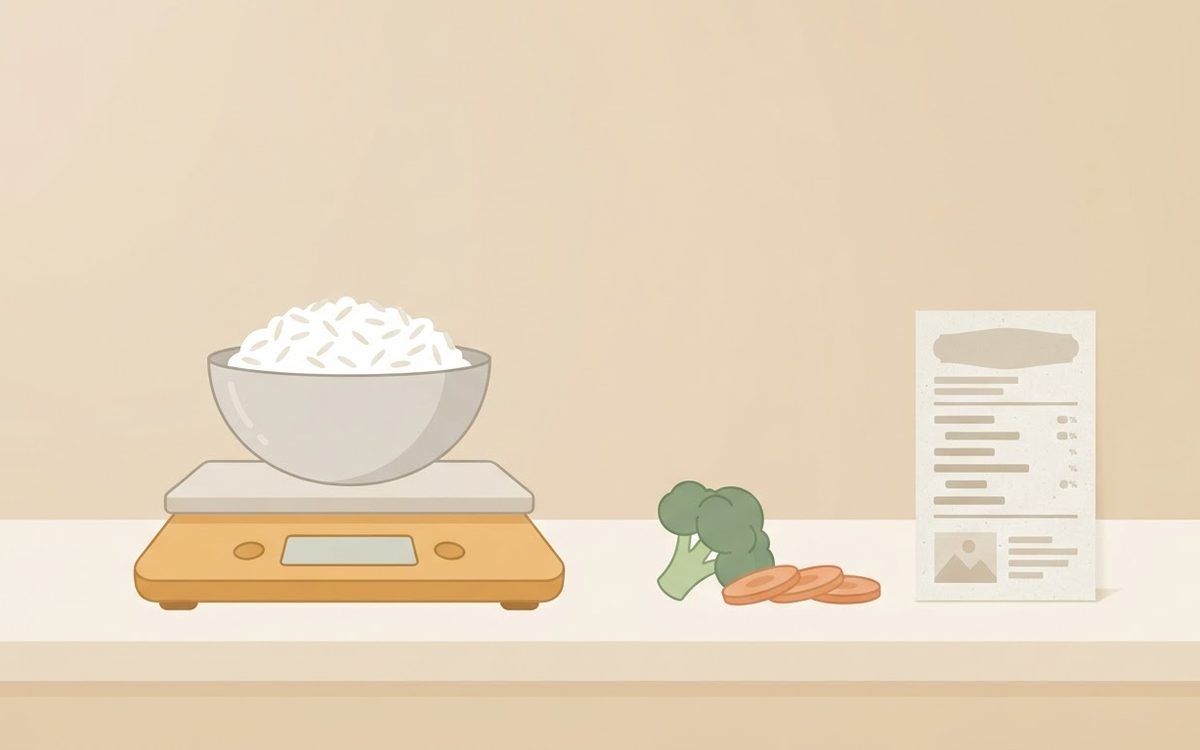
Tare, raw-versus-cooked weights, reading nutrition labels and a low-stress way to keep a food log — a practical guide to using a kitchen scale without turning every meal into maths.
Conteúdo
Affiliate link: We may earn a commission if you purchase through this link, at no additional cost to you. See our Affiliate Disclosure.
A kitchen scale does exactly one thing: it tells you how much something weighs. It does not measure calories, protein, potassium or phosphorus. Yet for people who have been given a nutrition target — a protein limit in kidney disease, a carbohydrate budget in diabetes, a potassium or phosphorus limit on dialysis — a scale is the bridge between "a portion" on paper and the food actually on the plate.
This guide shows how to use one well, and how to keep it from becoming a source of stress.
1. The basics: tare, containers and units
- Tare (zero) — place your empty plate or bowl on the scale, press tare (sometimes marked zero or T), and the display returns to 0. Whatever you add is now weighed on its own. You can tare repeatedly: add rice, tare, add chicken, tare, add vegetables — each weight is recorded before you zero again.
- Container weight — if your scale has no tare button, weigh the empty container first and subtract it.
- Units — most scales switch between grams and ounces. Grams are easier for nutrition labels, which almost always use grams per 100 g or per serving.
- Placement — use a flat, hard surface. A scale on a cutting board or tablecloth will give unstable readings.
- Capacity and resolution — typical kitchen scales read to 1 g up to about 5 kg. That is more than enough; you do not need laboratory precision.
Most inexpensive digital scales handle all of this. If you are shopping for one, this is a digital kitchen scale sold on Amazon: Greater Goods digital kitchen / food scale. We have not tested this unit ourselves — please read current reviews and check that it has a tare function and the units you prefer. (Affiliate link: We may earn a commission if you purchase through this link, at no additional cost to you.)
2. Raw or cooked? Weigh the same way the label does
This is the most common source of confusion.
Food loses or gains water when cooked. 100 g of raw rice becomes roughly 250–300 g cooked; 100 g of raw chicken breast becomes roughly 70–75 g cooked. The nutrients mostly stay the same (apart from some water-soluble vitamins and minerals), but the weight changes a lot.
Practical rules:
- Check what the label or food database refers to. Packaged dry foods (rice, pasta, oats) are usually labelled per 100 g uncooked. Many food databases list both raw and cooked entries — pick the one that matches what you weighed.
- Be consistent. If your dietitian gave you a portion in cooked weight, weigh cooked. If the target is raw weight, weigh raw before cooking.
- Potassium and boiling: boiling vegetables and potatoes in plenty of water and discarding the water removes a meaningful share of potassium. This is why many kidney-diet guides describe weighing raw, then boiling. Follow the specific instructions your dietitian gave you.
3. Turning grams into nutrition with the label
Nutrition labels state values per 100 g and often per serving. The arithmetic is simple:
nutrient in your portion = (label value per 100 g) × (your weight in g ÷ 100)
Example: a yoghurt label says 4.5 g protein per 100 g. You weighed 150 g. Protein = 4.5 × 1.5 = 6.75 g.
Tips that keep this manageable:
- Work out your usual portions once, write them down, and reuse them. You do not need to recalculate the same breakfast every day.
- Round sensibly. 6.75 g is 7 g. Nutrition targets are ranges, not exact numbers.
- Use a reliable database for unlabelled foods (fresh produce, meat, home-cooked dishes). Government databases such as the USDA FoodData Central or your country's national food composition table are free and reasonably accurate. Our Potassium & Phosphorus Lookup tool is built on this kind of public data for common foods.
- Watch for "phosphate additives" on ingredient lists (words containing phos-). These are absorbed far more completely than natural phosphorus and are not always reflected in the label number — relevant if you have been asked to limit phosphorus.
4. A food log that lasts longer than a week
Detailed tracking of every gram, every day, is exhausting and most people stop within a fortnight. Approaches that tend to survive:
- Weigh for a learning period, not forever. Two or three weeks of weighing typical meals teaches you what 30 g of cheese or 100 g of cooked rice looks like. After that, weigh only when you are unsure or when something changes.
- Track the one or two nutrients that matter to you, not everything. If your target is protein, log protein. If it is potassium, log potassium.
- Photograph plates. A quick photo plus a one-line note ("rice ~150 g, fish ~100 g") is a useful record for a dietitian appointment and takes seconds.
- Use a "repeat meals" list. Most of us eat the same 10–15 meals. Once they are calculated, they are done.
- Review weekly, not daily. Look at the pattern over seven days together with how you felt and, if relevant, your lab results.
5. What a scale cannot tell you — and who should not over-track
A scale measures weight. It does not know what the food contains, how it was prepared, how much you absorbed, or whether your body needs more or less today. Lab values, symptoms and your clinician's assessment decide whether a dietary approach is working.
Not everyone should weigh food. If you have a history of disordered eating, if tracking makes you anxious, or if your clinician has not asked you to limit anything, there is no need to start. Portion awareness can also come from hand-size guides, measuring cups or simply looking at your plate. The goal of any of these tools is a diet that supports your health and that you can live with.
If you have kidney disease, diabetes, liver disease or another condition with specific dietary targets, ask to see a registered dietitian who works with your condition. They can translate your blood results into practical portions — and tell you when weighing is helpful and when it is unnecessary.
Summary
- Tare before adding food; weigh in grams.
- Weigh the same way the label or database does (raw vs cooked) and stay consistent.
- Convert with label value × (weight ÷ 100); round sensibly.
- Weigh to learn portions, then weigh only when unsure.
- A scale measures weight, not nutrition — let your lab results and dietitian guide the targets.
References
- U.S. Department of Agriculture. FoodData Central. https://fdc.nal.usda.gov/
- National Kidney Foundation. Potassium and Your CKD Diet. https://www.kidney.org/atoz/content/potassium
- National Kidney Foundation. Phosphorus and Your Diet. https://www.kidney.org/atoz/content/phosphorus
- Academy of Nutrition and Dietetics. Portion Distortion and Serving Sizes. https://www.eatright.org/
- KDOQI Clinical Practice Guideline for Nutrition in CKD: 2020 Update. Am J Kidney Dis 2020;76(3 Suppl 1):S1-S107. https://doi.org/10.1053/j.ajkd.2020.05.006
This article is general health information from a patient-run site and does not replace advice from your own doctor or dietitian.
Where to go next
Related knowledge
查核:「植物性蛋白一定比動物性蛋白護腎,吃素就能保腎」有多少證據?
部分正確:植物性蛋白在代謝負擔、血磷等面向多半較有利腎臟,但「一定比較好、吃素就能保腎」太絕對,目前僅屬可能有保護效果,且需注意蛋白質足量與鉀、磷控制。[1][2][3]
查核:「腎臟病患者要盡量不吃蛋白質、最好完全吃素」是真的嗎?
結論:不成立。指引建議「適度限蛋白」,不是完全不吃或一律吃素;吃太少反而會導致營養不良與肌肉流失。[1][2][3]
Glycemic Index Food Guide for Diabetic Kidney Patients: Full Low/Medium/High GI Table, Recommended and Not-Recommended Lists, and How to Balance Potassium, Phosphorus and Protein
Diabetes plus kidney disease is the hardest diet to manage: control glucose, limit potassium and phosphorus, and get protein just right.
Lived experience

After Rebirth: From Dialysis Patient to Health Educator — Choosing to Return to the Ward
Shock at birth led to chronic glomerulonephritis; dialysis began at 26; a kidney transplant came on Christmas Day at 32.

Why Did I End Up on Dialysis?
A difficult birth, shock and oxygen deprivation damaged both my kidneys. As a teenager I skipped my medication. At 26, a single glass of orange juice sent me straight to the emergency room.
