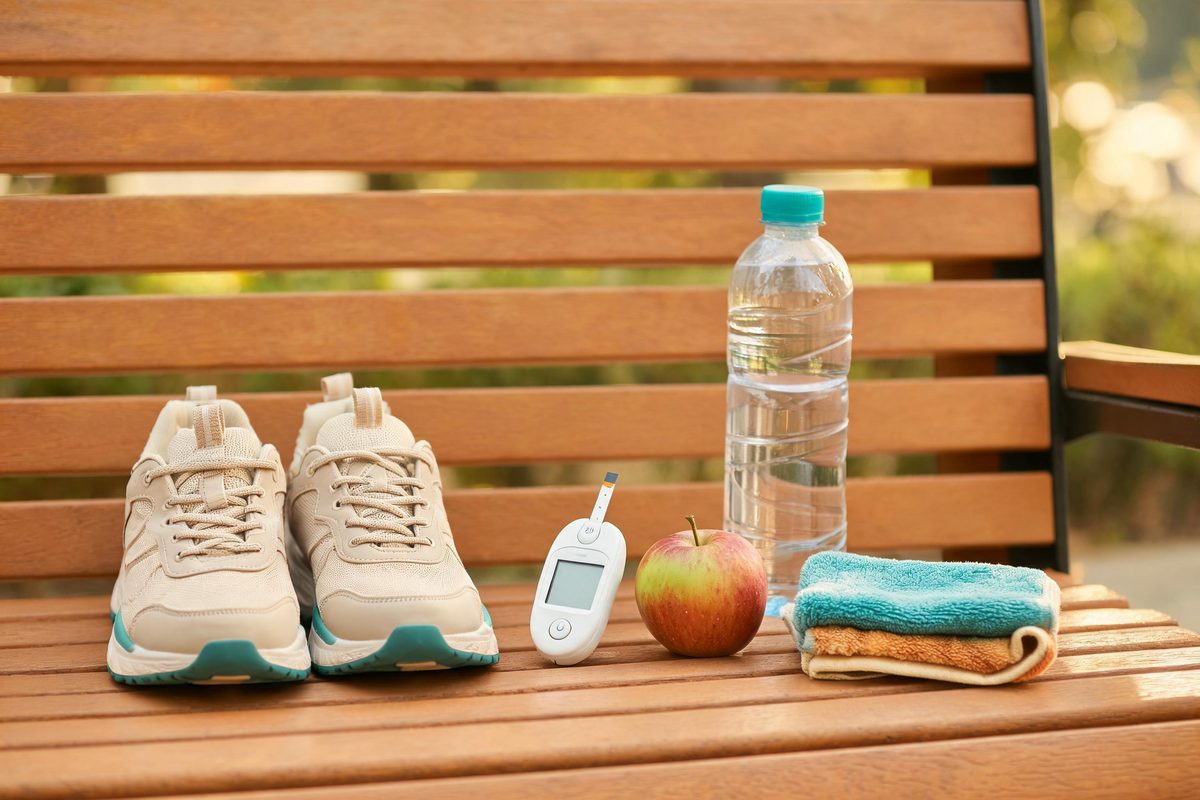
How Diabetic Kidney Patients Should Train: When to Check Glucose, When Not to Train, the Science of Post-Meal Walking, Protecting Feet and Eyes, and Adjustments for Insulin and SGLT2 Users
People with diabetes and kidney disease gain the most from exercise (glucose, blood pressure and albuminuria all improve) but must manage three special problems: hypoglycaemia, foot injury and retinopathy. Based on ADA 2025 and KDIGO 2022, this article explains how to read glucose before, during and after exercise, why post-meal walking works, when not to train, how insulin and each glucose-lowering drug class interact with exercise, and gives a sample week.
Who this is for: type 2 (or type 1) diabetes with CKD stages 3–5, diabetic dialysis patients, post-transplant diabetes. Medication changes must be confirmed with your prescriber — this article explains principles only.
1. Why the "return on investment" is highest for diabetic kidney patients
- Glucose: regular exercise lowers HbA1c by 0.5–0.7% (ADA 2025, meta-analyses) — as much as an oral drug.
- Albuminuria: 12 weeks of aerobic + resistance training lowers urine albumin by 10–25% (Hellberg et al., 2019).
- Blood pressure: systolic down 5–7 mmHg.
- Cardiovascular death: diabetic CKD carries 2–3× the cardiovascular risk of diabetes alone; exercise is one of the few interventions that lowers every risk factor at once.
- Muscle is the largest glucose store: contracting muscle takes up glucose via GLUT4 without insulin, and insulin sensitivity stays higher for 24–48 h. More muscle = easier glucose control — which is why strength training matters so much here.
2. Reading pre-exercise glucose (ADA 2025)
| Pre-exercise glucose | Action |
|---|---|
| <90 mg/dL (5.0 mmol/L) | Take 15–30 g carbohydrate (half slice of bread, 3 glucose tablets); start when >90 after 15 min |
| 90–150 | OK to exercise; for long sessions or insulin users take 10–15 g carbohydrate first |
| 150–250 | Ideal range — go |
| 250–300 | Light exercise only; skip if unwell or ketones present |
| >300 | Type 1 or ketones: do not exercise; type 2 without ketones and feeling well: light only, hydrate within your fluid allowance |
Kidney-specific warning: with reduced kidney function insulin and many oral agents are cleared more slowly and act longer; hypoglycaemia risk is higher and lasts longer than in diabetes alone, and post-exercise lows can appear 6–15 hours later (overnight).
3. Treating hypoglycaemia (kidney version)
- Symptoms: sweating, shaking, palpitations, dizziness, slurred speech, sudden fatigue. Some kidney patients with neuropathy have no warning symptoms — test more often.
- Rule: 15 g fast sugar → re-test at 15 min → another 15 g if still <70.
- Kidney-friendly: 3–4 glucose tablets, 3 sugar cubes, 1 tbsp honey, 150 mL regular cola.
- Avoid: orange juice, banana, raisins (high potassium); chocolate (fat slows absorption).
- Carry glucose tablets and a card stating "diabetes, kidney disease".
4. The science of post-meal walking — the best time for diabetic kidney patients
- Walking 10–15 min starting 30–60 min after a meal cuts the post-meal glucose peak by 20–30% (DiPietro et al., 2013: three 15-min post-meal walks beat one 45-min walk).
- Why: glucose peaks 1–2 h after eating, exactly when contracting muscle pulls it in.
- Bonus for kidney patients: lowest hypoglycaemia risk (glucose is rising), no extra carbohydrate needed.
- Three times a day, 10–15 min each is the most realistic starting point.
5. Three organs to protect
1. Feet (diabetic foot)
- Inspect both feet before and after every session: blisters, redness, broken skin, moist toe webs.
- Well-fitting trainers + seamless synthetic socks; never barefoot or in sandals.
- With peripheral neuropathy (numbness, poor sensation): avoid long running and jumping; prefer cycling, swimming (not on dialysis), rowing, upper-body and seated training.
- Active ulcer: no weight-bearing on that foot — train the upper body and the other leg.
2. Eyes (retinopathy)
- Proliferative retinopathy or recent laser/injection: avoid breath-holding (Valsalva), head-below-heart positions (inversions, downward dog), jarring impact, boxing, loads >50% of one-rep max.
- Mild–moderate non-proliferative: no restriction; annual retinal exam.
- Exhale on effort when lifting — never hold your breath.
3. Heart and autonomic nerves
- With autonomic neuropathy heart rate responds sluggishly: don't use heart rate to gauge intensity — use the talk test or RPE 11–13/20.
- Postural hypotension is common: rise slowly; always cool down 5 min.
- Silent ischaemia is more frequent: chest tightness, unusual breathlessness, jaw or arm discomfort — stop and seek care even if mild.
6. Medication adjustment principles (confirm with your doctor)
| Drug | Hypo risk | Exercise notes |
|---|---|---|
| Insulin | High | Rapid-acting insulin 1–2 h before exercise may need a 25–50% cut; don't inject into the working muscle (thigh); basal adjusted by your doctor |
| Sulfonylureas (glimepiride, gliclazide) | High, higher with low eGFR | Test before and after; many nephrologists switch these |
| Metformin | Low | Stop if eGFR <30; no exercise adjustment needed |
| SGLT2 inhibitors | Low | Diuretic effect + sweating → dehydration/hypotension; mind fluids (within allowance); pause when unwell |
| GLP-1 agonists | Low | Reduce intensity if nauseated; weight loss improves tolerance |
| DPP-4 inhibitors | Low | Nothing special |
| Steroids (transplant) | Raise glucose (highest in afternoon) | Afternoon exercise helps most |
7. Sample week (CKD 3–4, type 2 diabetes, age 60)
| Day | Content |
|---|---|
| Mon | 15-min walk after each meal; 30-min strength in the evening (sit-to-stand, band row, wall push-up, bridge — 12 reps × 2) |
| Tue | Post-meal walks; 10 min balance (single-leg stand at a chair, heel-to-toe walk) |
| Wed | Post-meal walks; 30-min strength (add dumbbell press, wall squat, bird-dog) |
| Thu | Post-meal walks; 10 min stretching |
| Fri | Post-meal walks; 30-min strength |
| Sat | Longer walk or cycle 30–40 min (moderate) |
| Sun | Rest or easy stroll |
Totals: ~315 min aerobic/week (including post-meal walks) + 3 strength sessions — above the KDIGO/ADA 150 min + 2 strength sessions.
On dialysis: replace "post-meal walks" with "30 min on the bike during dialysis + post-meal walks on non-dialysis days"; glucose is less stable on dialysis days — test before and after.
8. Reminders
- Log exercise time and pre/post glucose; review trends with your doctor after two weeks.
- When ill (cold, diarrhoea, not eating): pause exercise and also SGLT2 inhibitors, metformin and diuretics (sick-day rule).
- Halve intensity and test more often the first time you try a new activity.
- Don't start new high-intensity work at the peak of insulin action.
Sources
- American Diabetes Association. Standards of Care in Diabetes—2025, Section 5 (Physical Activity). Diabetes Care 2025;48(Suppl 1).
- Colberg SR, et al. Physical Activity/Exercise and Diabetes: ADA Position Statement. Diabetes Care 2016;39:2065–2079.
- KDIGO. 2022 Clinical Practice Guideline for Diabetes Management in CKD, Chapter 2. Kidney Int 2022;102(5S).
- Hellberg M, et al. RENEXC: RCT of exercise in CKD. Nephrol Dial Transplant 2019;34:1538–1546.
- DiPietro L, et al. Three 15-min bouts of moderate postmeal walking. Diabetes Care 2013;36:3262–3268.
- Umpierre D, et al. JAMA 2011;305:1790–1799.
- Riddell MC, et al. Exercise management in type 1 diabetes: consensus. Lancet Diabetes Endocrinol 2017;5:377–390.
- IWGDF. Guidelines on the prevention and management of diabetic foot disease 2023. https://iwgdfguidelines.org/
Related Reading
15 Practical Fitness Tips for Kidney Patients: Using RPE for Intensity, Progressive Overload, Protein Without Harming Your Kidneys, SARC-F Sarcopenia Self-Test, Warm-up & Breathing, Hydration and the Potassium in Sports Drinks
Once you know you *should* exercise, the real sticking points are how, how much, and what to eat. This article answers the 15 questions kidney patients ask most: the RPE scale, how much weight to add each week, protein targets for non-dialysis CKD / dialysis / transplant, what to eat after training, the 5-question SARC-F test, warm-up and cool-down, breathing, the potassium content of sports drinks, and which symptoms mean stop. Every tip cites its evidence.

How Should Kidney Transplant Recipients Train? Protecting the Graft, Steroid & Immunosuppressant Effects, Phase-by-Phase Post-Surgery Program, and Countering Post-Transplant Diabetes & Bone Loss
A successful transplant is not the finish line; it is the start of rebuilding a body that dialysis and medication have worn down. Based on the KDIGO transplant guideline and transplant-recipient exercise RCTs, this article explains where the graft sits and which movements to avoid; how prednisolone and tacrolimus affect muscle and glucose; what to train at 0–6 weeks, 6–12 weeks and beyond 3 months; and how training counters post-transplant diabetes, bone loss and cardiovascular risk.
How Dialysis Patients Should Train: A 12-Week Program for Hemodialysis and Peritoneal Dialysis — Intradialytic Exercise, Fistula Protection, Abdominal Pressure, Potassium and Fluids
Dialysis patients need training the most and are told to "take it easy" the most. Based on Cochrane 2022, KDOQI and renal rehabilitation guidelines, this article gives separate 12-week plans for HD and PD: when to train (on dialysis / non-dialysis days), what to train (aerobic + strength + balance), how to handle the fistula arm, which movements PD patients must avoid, how to manage potassium and dehydration, and eight exercises you can do in the dialysis chair.