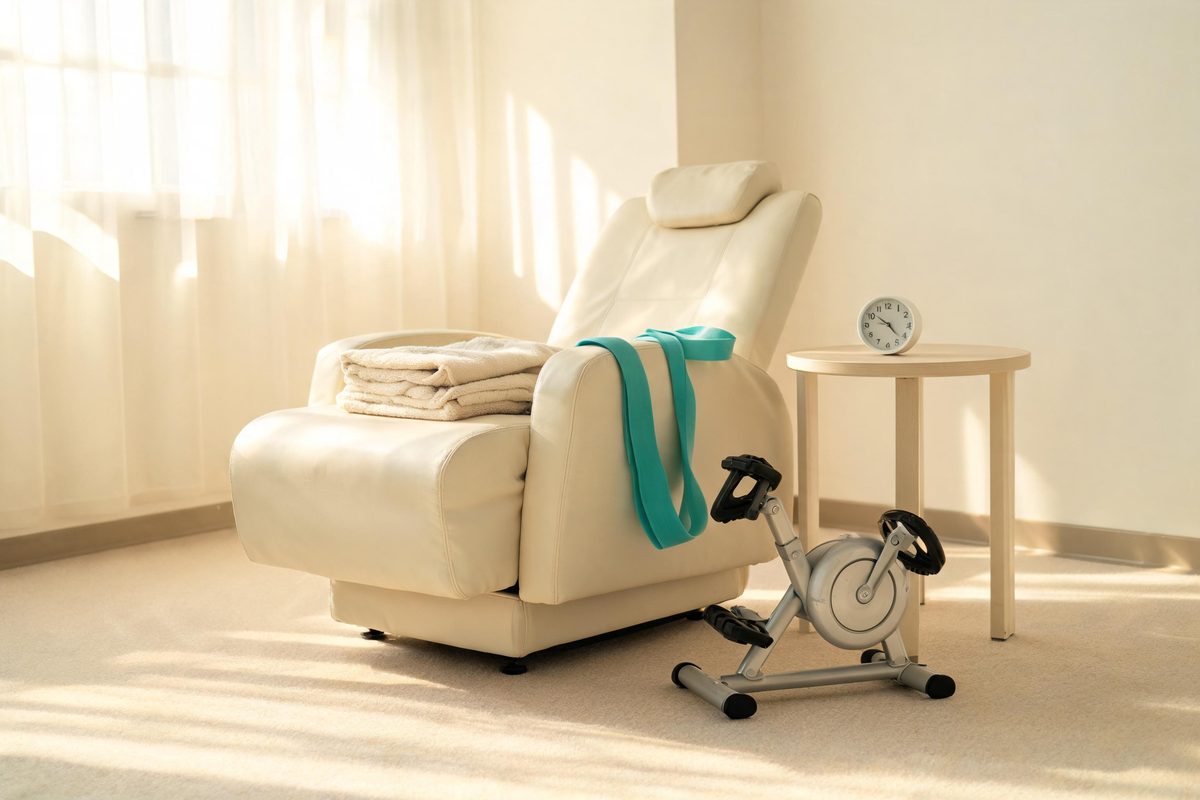
How Dialysis Patients Should Train: A 12-Week Program for Hemodialysis and Peritoneal Dialysis — Intradialytic Exercise, Fistula Protection, Abdominal Pressure, Potassium and Fluids
Dialysis patients need training the most and are told to "take it easy" the most. Based on Cochrane 2022, KDOQI and renal rehabilitation guidelines, this article gives separate 12-week plans for HD and PD: when to train (on dialysis / non-dialysis days), what to train (aerobic + strength + balance), how to handle the fistula arm, which movements PD patients must avoid, how to manage potassium and dehydration, and eight exercises you can do in the dialysis chair.
Before this article: read "Why kidney patients should exercise" to rule out contraindications (uncontrolled blood pressure, potassium >6.0, acute infection, unstable heart disease). These are general principles — confirm intensity with your nephrologist, dialysis nurse or physiotherapist.
1. Three core principles for dialysis patients
- Timing beats intensity: on HD days, exercise during the first two hours of dialysis or before it; save higher intensity for non-dialysis days. The 2–3 hours after dialysis are the least stable for blood pressure and fluids.
- Strength before cardio: muscle is what dialysis patients lose fastest. Aerobic work maintains the heart and lungs; only resistance training reverses sarcopenia and protein-energy wasting.
- Protect the access: fistula/graft for HD, catheter exit site and abdominal pressure for PD. These define the "don'ts".
2. Hemodialysis: three training windows
A. Intradialytic exercise — strongest evidence, least time
- When: start 30 min after going on, finish within the first two hours (blood pressure drops later).
- What: recumbent bike or pedal exerciser 20–45 min, "a little breathless but can talk" (RPE 11–13/20). Without equipment: leg bands, straight-leg raises, ankle pumps, knee extensions.
- Evidence: Kt/V up ~10%, longer 6-minute walk, less depression (Sheng 2014; Bernier-Jean 2022).
- Cautions: support only with the non-fistula arm; stop at once with chest pain, BP drop >20 mmHg or cramps; have the nurse confirm today's dry weight and ultrafiltration target first.
B. Non-dialysis days — strength days
- 2–3 times a week, 30–45 min.
- 8–10 exercises covering legs, hips, back, chest, core; 10–15 reps × 2–3 sets, last two reps should feel hard.
- Equipment: resistance bands, dumbbells (from 1–5 kg), a chair, body weight.
C. Every day — walking and activity
- Target 5,000–7,500 steps/day (start at your current count + 500).
- Stand for 2 minutes every hour of sitting.
3. The 12-week plan (hemodialysis)
| Week | During dialysis (each session) | Strength on non-dialysis days (2×/week) | Daily steps |
|---|---|---|---|
| 1–2 | Pedal 10–15 min, no resistance | Sit-to-stand, wall push-up, band row, calf raise: 8–10 reps × 1 set | current + 500 |
| 3–4 | Pedal 15–20 min, light resistance | Same × 2 sets; add glute bridge, standing side leg raise | + 1,000 |
| 5–6 | Pedal 20–30 min | 10–12 reps × 2 sets; add dumbbell shoulder press (non-fistula arm first), wall squat | + 1,500 |
| 7–8 | Pedal 30 min, moderate | 12–15 reps × 2–3 sets; add 0.5–1 kg | 5,000 |
| 9–10 | Pedal 30–40 min | 3 sets; add supported lunges, bird-dog | 6,000 |
| 11–12 | Pedal 40–45 min, intervals (2 min hard / 1 min easy) | 3 sets, last reps hard; re-test grip and 5× sit-to-stand | 7,000+ |
Progression rule: 3 sets of 15 reps feel easy → add weight or resistance next time.
4. The fistula arm
Allowed
- Once the fistula is mature (usually 6–8 weeks post-op and cleared by the doctor), the fistula arm can do low-to-moderate load work: grip ball, light dumbbell curls (≤3–5 kg), band rows.
- Grip training (3 sets × 10–15 daily) is even recommended during maturation to help the fistula develop (Fontseré et al., 2016).
Not allowed
- Anything that compresses the fistula: elbows digging into the forearm in push-ups, a barbell resting on the forearm, backpack straps across the upper arm.
- Breath-holding (Valsalva) heavy lifts: sudden venous pressure spikes.
- Blood pressure cuffs, needles or tight wrist straps on that arm.
- First 2 weeks after surgery: fingers and wrist only.
Graft (AVG): as above, with extra care against compression and knocks; higher infection risk — clean after sweating.
Catheter (CVC): keep the site dry (no swimming), avoid excessive shoulder traction; walking and leg training are unrestricted.
5. Peritoneal dialysis: abdominal pressure is the key
PD patients are usually more cardiovascularly stable and can do more than HD patients, but:
| Issue | Why | What to do |
|---|---|---|
| Hernia risk | 1.5–2.5 L of fluid raises abdominal pressure | Drain before core work and lifting (or use a smaller fill); avoid sit-ups, double-leg raises, breath-hold lifting |
| Exit site | Traction, sweat, immersion | Secure the catheter with a belt; redress after sweating; no swimming unless cleared with a waterproof dressing (sea better than public pools) |
| Leak | First 2–4 weeks after insertion | Walking only for 4 weeks |
| Glucose | Absorbed from dialysate | Diabetic PD patients check glucose before and after |
Recommended: walking, stationary bike, non-swimming water exercise (depending on catheter), tai chi, band training, light core after draining (dead bug, bird-dog, short side planks).
Avoid: sit-ups, crunches, heavy deadlifts, heavy breath-hold squats, contact sports.
APD (overnight cycler): the abdomen is empty or nearly so by day — the ideal exercise window.
6. Potassium, fluids, glucose
- Potassium: muscle releases potassium during exercise, raising serum K by 0.5–1.0 mmol/L transiently; if pre-dialysis K is already >5.5, keep it light that day; don't gulp sports drinks afterwards (high K).
- Fluids: dialysis patients cannot "drink more" to replace sweat. Train in cool hours, indoors, avoid heavy sweating; use ice chips or lemon slices for thirst; if you sweat a lot, discuss a small adjustment to that day's fluid allowance — never loosen it yourself.
- Blood pressure: if you run low after dialysis, measure first; don't exercise below 100/60.
- Glucose (diabetics): see the next article.
7. Eight exercises in the dialysis chair (no equipment)
- Ankle pumps: flex and point, 20 reps.
- Straight-leg raise: lift one straight leg 10 cm, hold 3 s, 10 × 2.
- Knee extension: straighten the lower leg, hold 3 s, 15 reps.
- Glute squeeze: squeeze 5 s, release, 15 reps.
- Diaphragmatic breathing + abdominal draw-in: 10 breaths.
- Grip ball (non-fistula hand): 3 × 15.
- Scapular retraction: pull shoulders back, hold 5 s, 10 reps.
- Seated marching: alternate knee lifts, 2 min.
One round per hour ≈ 10 min.
8. When to stop, when to adjust
Stop immediately: chest pain/tightness, severe breathlessness, near-fainting, very fast or irregular heartbeat, sudden fistula pain/swelling or loss of thrill, severe exit-site pain or leakage.
Go light today: pre-dialysis K >5.5, BP >180/110 or <100/60, >3 kg above dry weight, fever, arm just dressed or needled.
Re-evaluate the plan: re-test 6-minute walk, 5× sit-to-stand and grip at 3 months; if no progress, check protein intake (1.0–1.2 g/kg/day on dialysis), anaemia, acidosis and parathyroid hormone.
Sources
- Bernier-Jean A, et al. Cochrane Database Syst Rev 2022;1:CD014653.
- Sheng K, et al. Am J Nephrol 2014;40:478–490.
- Cheema B, et al. PEAK. J Am Soc Nephrol 2007;18:1594–1601.
- Fontseré N, et al. Effect of a postoperative exercise program on arteriovenous fistula maturation: RCT. Hemodial Int 2016;20:306–314.
- Painter P, et al. Am J Kidney Dis 2000;35:482–492.
- Baker LA, et al. UK Kidney Association clinical practice guideline: exercise and lifestyle in CKD. BMC Nephrol 2022;23:75.
- Japanese Society of Renal Rehabilitation. Guideline for Renal Rehabilitation 2018. Ren Replace Ther 2019;5:28.
- Bennett PN, et al. Intradialytic exercise: Global Renal Exercise Network consensus. Nephrol Dial Transplant 2022;37:1467.
- Isnard-Rouchon M, et al. Exercise and peritoneal dialysis: ISPD practice points. Perit Dial Int 2022;42:8–24.
- K/DOQI. Am J Kidney Dis 2005;45(4 Suppl 3).
관련 글
15 Practical Fitness Tips for Kidney Patients: Using RPE for Intensity, Progressive Overload, Protein Without Harming Your Kidneys, SARC-F Sarcopenia Self-Test, Warm-up & Breathing, Hydration and the Potassium in Sports Drinks
Once you know you *should* exercise, the real sticking points are how, how much, and what to eat. This article answers the 15 questions kidney patients ask most: the RPE scale, how much weight to add each week, protein targets for non-dialysis CKD / dialysis / transplant, what to eat after training, the 5-question SARC-F test, warm-up and cool-down, breathing, the potassium content of sports drinks, and which symptoms mean stop. Every tip cites its evidence.
How Should Kidney Transplant Recipients Train? Protecting the Graft, Steroid & Immunosuppressant Effects, Phase-by-Phase Post-Surgery Program, and Countering Post-Transplant Diabetes & Bone Loss
A successful transplant is not the finish line; it is the start of rebuilding a body that dialysis and medication have worn down. Based on the KDIGO transplant guideline and transplant-recipient exercise RCTs, this article explains where the graft sits and which movements to avoid; how prednisolone and tacrolimus affect muscle and glucose; what to train at 0–6 weeks, 6–12 weeks and beyond 3 months; and how training counters post-transplant diabetes, bone loss and cardiovascular risk.
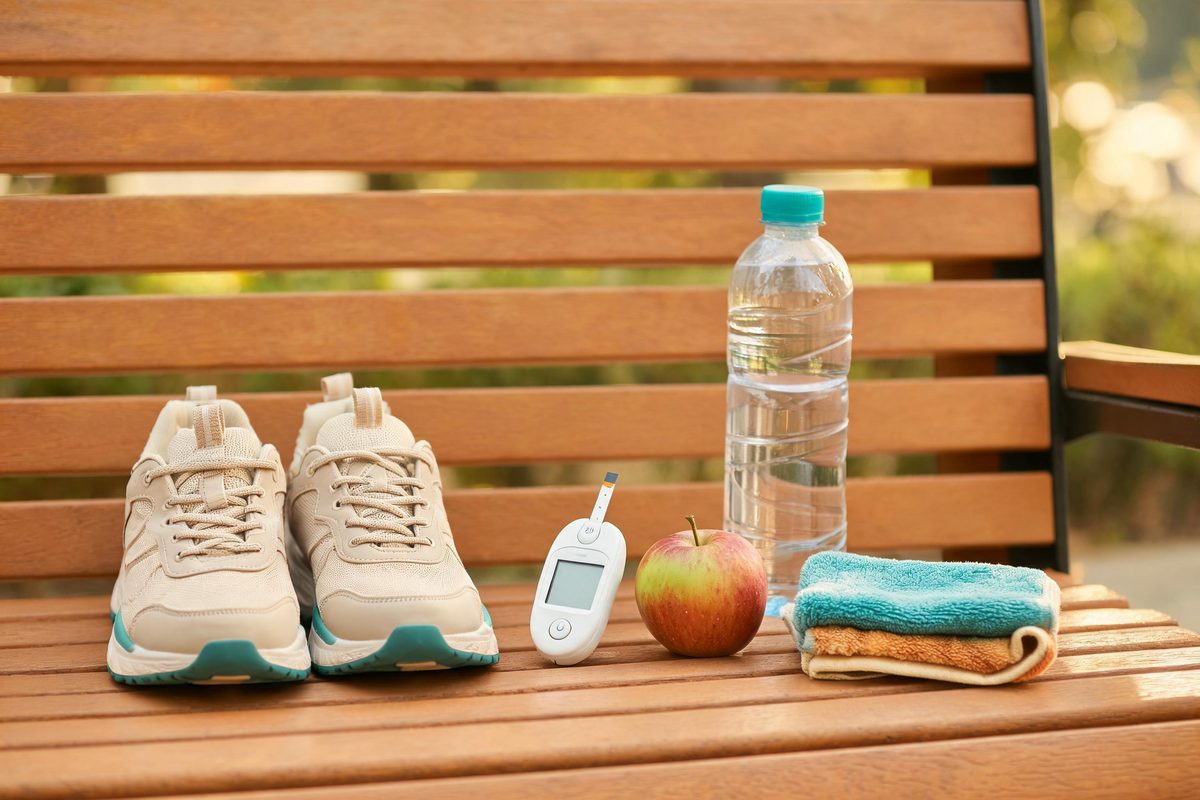
How Diabetic Kidney Patients Should Train: When to Check Glucose, When Not to Train, the Science of Post-Meal Walking, Protecting Feet and Eyes, and Adjustments for Insulin and SGLT2 Users
People with diabetes and kidney disease gain the most from exercise (glucose, blood pressure and albuminuria all improve) but must manage three special problems: hypoglycaemia, foot injury and retinopathy. Based on ADA 2025 and KDIGO 2022, this article explains how to read glucose before, during and after exercise, why post-meal walking works, when not to train, how insulin and each glucose-lowering drug class interact with exercise, and gives a sample week.