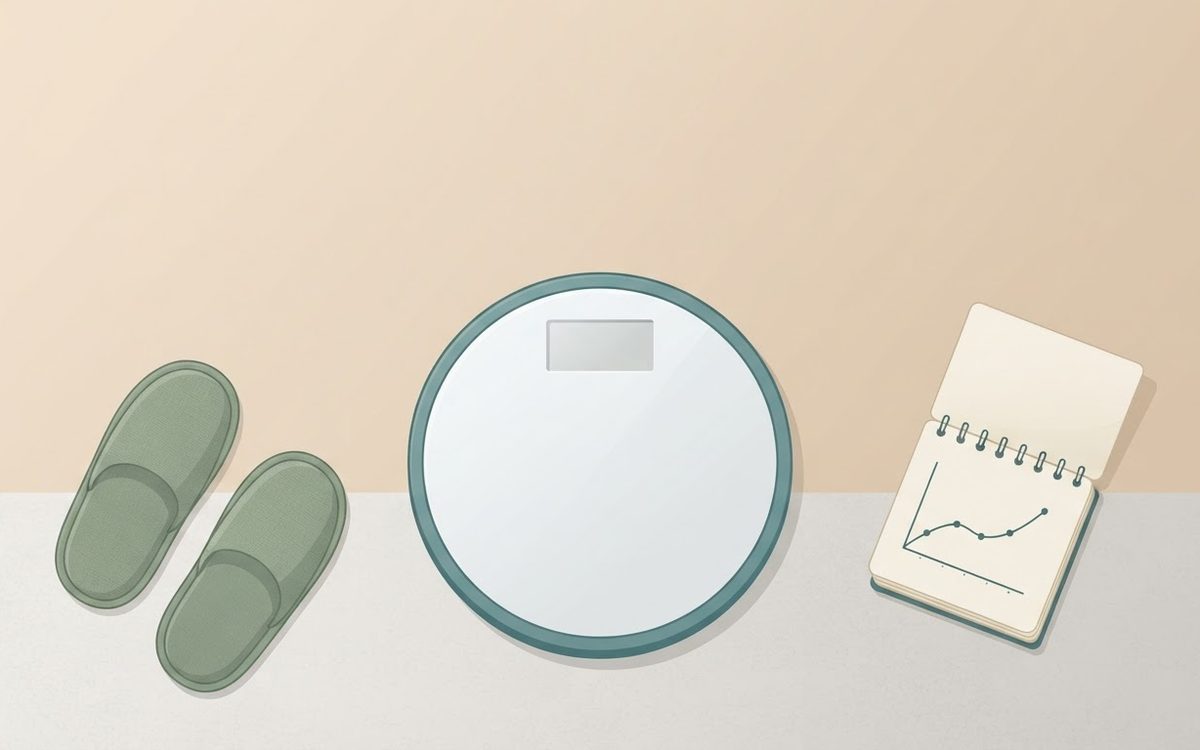
A plain-language guide to picking a bathroom scale that fits your purpose and budget, understanding what body-fat estimates can and cannot tell you, and building a measuring habit that is actually useful to discuss with your care team.
목차
- 1. Start with the purpose, not the features
- 2. Practical features worth paying attention to
- 3. Weight only means something under the same conditions
- 4. Body-fat and muscle estimates: useful, but understand the limits
- 5. Building a habit you can keep
- 6. What else is worth tracking alongside weight?
- 7. Which changes are worth discussing with your care team?
- Summary
- References
Affiliate link: We may earn a commission if you purchase through this link, at no additional cost to you. This guide names no specific scale brand or model. The product link below is a blood-pressure monitor, mentioned in the "what else to track" section. See our Affiliate Disclosure.
A bathroom scale is one of the cheapest health tools you can own, and one of the easiest to misuse. A single number on a single morning tells you very little. A trend over weeks, measured the same way each time, can tell you quite a lot — especially if you live with a condition where fluid balance matters, such as kidney disease, heart failure or liver disease.
This guide is about choosing a scale that you will actually keep using, and about knowing what the numbers mean.
1. Start with the purpose, not the features
Before comparing scales, decide what the scale is for:
- General weight trend — you want to see whether your weight is stable, rising or falling over months. Almost any accurate scale will do.
- Daily fluid monitoring — people on dialysis, with heart failure or on diuretics are often asked to weigh themselves every morning and report sudden gains. Here, consistency and readability matter far more than extra features.
- Body-composition curiosity — you are interested in body-fat or muscle estimates. These scales exist, but their estimates have important limits (see section 4).
Writing one sentence — "I want this scale to help me ___" — usually narrows the choice immediately.
2. Practical features worth paying attention to
| Feature | Why it matters | What to look for |
|---|---|---|
| Accuracy and increments | Trend tracking needs consistency more than decimals | 0.1 kg / 0.2 lb increments are plenty for home use |
| Display | Many readers weigh in a dim bathroom or without glasses | Large, high-contrast digits; backlight if you weigh early |
| Platform size and surface | Stability affects both safety and readings | Wide, non-slip platform; avoid very small glass tops if balance is a concern |
| Weight capacity | Scales have an upper limit | Check the stated maximum before buying |
| Battery type | Dead batteries end habits | Common sizes (AAA) or USB-rechargeable |
| Floor compatibility | Carpet gives unreliable readings on most scales | Plan to use it on a hard, flat floor |
| Memory / app | Optional; a paper log works just as well | Only pay for it if you will actually use it |
A simple, sturdy scale with a big display is a better long-term purchase than a feature-rich one that is fiddly to use.
3. Weight only means something under the same conditions
Body weight changes by a kilogram or more within a single day because of food, drink, clothing and the bathroom. To make readings comparable:
- Weigh at the same time — most commonly first thing in the morning, after using the toilet, before eating or drinking.
- Wear the same amount (ideally none, or the same light clothing).
- Use the same scale on the same floor spot.
- Record the number immediately, in a notebook, phone note or the scale's app.
Then look at the weekly average, not individual days. A one-day jump after a salty meal is normal; a steady climb over two weeks is the kind of pattern worth noticing.
If you are on dialysis, your care team may have given you a target (dry) weight and a rule such as "call us if you gain more than X kg between sessions". Follow their instructions rather than any general guidance here. Our Dialysis Passport tool lets you record that target weight alongside your medication list.
4. Body-fat and muscle estimates: useful, but understand the limits
Many scales offer "body composition" readings using bioelectrical impedance analysis (BIA): a tiny, harmless electrical current passes through your feet, and the scale estimates body fat, muscle mass, body water and more from the resistance it measures.
What you should know:
- These are estimates derived from a formula, not direct measurements. The formula assumes typical hydration. Anything that changes your body water — a large drink, a hot day, menstruation, fluid retention, dialysis — shifts the estimate.
- For the same reason, the absolute number (e.g. "24 % body fat") can be off by several percentage points. The direction of change under consistent conditions is more informative than the number itself.
- People with implanted electronic devices such as pacemakers are generally told to avoid BIA scales; check the manufacturer's instructions and ask your doctor.
- If you have significant fluid shifts (dialysis, heart failure, liver disease with ascites), BIA body-fat readings can be particularly misleading. Weight trend and your care team's clinical assessment are more reliable.
In short: body-composition features are fine as an optional extra, but they are not a reason to pay much more, and they should not change medical decisions on their own.
5. Building a habit you can keep
The most accurate scale is useless in a cupboard. A few things that help:
- Keep the scale where you will step on it — out on the bathroom floor, not stored away.
- Attach it to an existing routine (after brushing teeth, before the shower).
- Decide in advance how often — daily if your care team asked for it, otherwise once or twice a week is enough for most people.
- Log it somewhere simple. A paper chart on the wall works. Our free Blood Pressure & Weight Log lets you record both in one place and shows the trend.
- Don't moralise the number. Weight goes up and down for many reasons. The log is information for you and your clinician, not a daily verdict.
6. What else is worth tracking alongside weight?
For many chronic conditions, weight is only one of several simple home measurements that give your care team a clearer picture:
- Blood pressure — the single most useful home measurement for kidney and heart health. Validated upper-arm monitors are recommended over wrist or finger models; you can check whether a model has passed independent validation on the STRIDE BP or Validate BP lists before buying. If you are looking for one, this is an upper-arm automatic monitor sold on Amazon: Konquest KBP-2704A upper-arm blood-pressure monitor — we have not tested this unit ourselves, so please check the validation lists and reviews before purchasing. (Affiliate link: We may earn a commission if you purchase through this link, at no additional cost to you.)
- Swelling — ankle or eyelid swelling that appears with a weight rise suggests fluid rather than fat.
- Breathlessness lying flat or needing more pillows — combined with weight gain, this should prompt a call to your clinic.
- Urine output (for people who still produce urine) — a noticeable fall together with weight gain is worth reporting.
7. Which changes are worth discussing with your care team?
A scale cannot diagnose anything, and this article is not medical advice. But these patterns are generally worth mentioning at your next visit — or sooner if you feel unwell:
- A steady, unexplained loss of more than about 5 % of your weight over 6–12 months.
- A rapid gain of 1–2 kg (2–4 lb) in a few days, especially with swelling or breathlessness.
- Weight that swings widely between dialysis sessions beyond the limit your team set.
- Any change that worries you, even if it is small. Bring your log — a dated list is far more useful to a clinician than a memory of "I think I've put on weight".
Summary
- Choose a scale for your purpose: stable, readable and easy to use beats feature-rich.
- Weigh under the same conditions and look at weekly trends.
- Body-fat estimates are approximate and hydration-dependent; don't over-interpret them.
- Pair weight with blood pressure and symptoms for a fuller picture.
- Bring a dated log to appointments and let your care team interpret it with you.
References
- National Kidney Foundation. Dialysis: Fluid Control and Dry Weight. https://www.kidney.org/atoz/content/dry-weight
- American Heart Association. Monitoring Your Blood Pressure at Home. https://www.heart.org/en/health-topics/high-blood-pressure/understanding-blood-pressure-readings/monitoring-your-blood-pressure-at-home
- STRIDE BP. Validated blood pressure monitors. https://www.stridebp.org/
- Kyle UG, et al. Bioelectrical impedance analysis — part I: review of principles and methods. Clinical Nutrition 2004;23(5):1226-43. https://doi.org/10.1016/j.clnu.2004.06.004
- Heart Failure Society of America. Daily Weights. https://hfsa.org/patient-hub/daily-weights
This article is general health information from a patient-run site and does not replace advice from your own doctor, nurse or dietitian.
Where to go next
Related knowledge

How to Use a Food Scale to Track Food Portions
Tare, raw-versus-cooked weights, reading nutrition labels and a low-stress way to keep a f…
Travel Medical Insurance: What to Check Before You Buy
Coverage limits, deductibles, exclusions, pre-existing-condition clauses, medical evacuati…

Traveling With a Chronic Condition: A Practical Planning Checklist
Medications across time zones, documents, finding care at your destination, pacing your it…
Lived experience

After Rebirth: From Dialysis Patient to Health Educator — Choosing to Return to the Ward
Shock at birth led to chronic glomerulonephritis; dialysis began at 26; a kidney transplan…
Why Did I End Up on Dialysis?
A difficult birth, shock and oxygen deprivation damaged both my kidneys. As a teenager I s…
