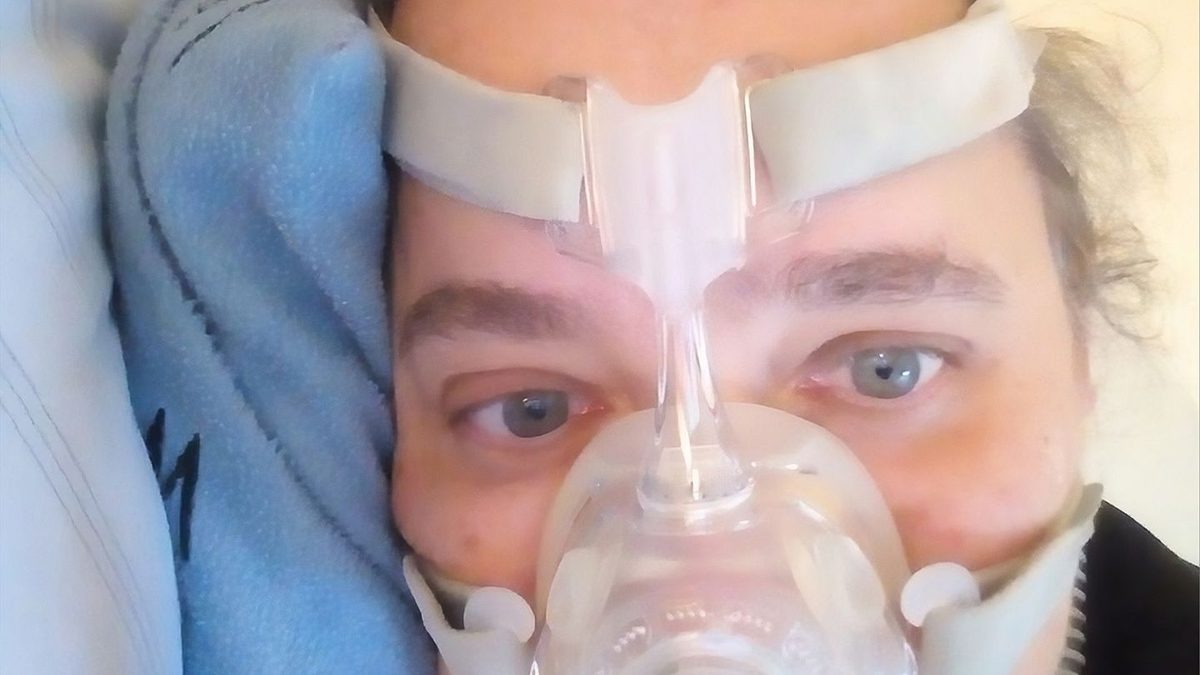
Obstructive Sleep Apnoea: Snoring Isn't Trivial — STOP-BANG Self-Screening, How Sleep Testing Works, What CPAP Improves, and Why Kidney Patients Are So Often Affected
Nearly a billion adults are estimated to have obstructive sleep apnoea, the vast majority undiagnosed. OSA is linked to hypertension, atrial fibrillation, stroke, diabetes and CKD progression. Based on American Academy of Sleep Medicine guidelines: symptoms, STOP-BANG, sleep testing, the evidence for CPAP and alternatives, and the 50%+ prevalence in dialysis.
Inhalt
What obstructive sleep apnoea (OSA) is
During sleep the upper airway repeatedly collapses, causing pauses in breathing (apnoeas) or shallow breathing (hypopnoeas). Oxygen falls and the brain briefly wakes to restore breathing — dozens to hundreds of times a night, usually without the person remembering. The result is fragmented sleep and intermittent hypoxia, daytime sleepiness, and long-term cardiovascular and metabolic harm [1][2].
A 2019 Lancet Respiratory Medicine analysis estimated about 936 million adults aged 30–69 have OSA (AHI ≥5) and 425 million have moderate–severe disease (AHI ≥15); 80–90% are undiagnosed [3].
Symptoms: more than snoring
- Loud snoring, witnessed pauses in breathing or waking gasping
- Daytime sleepiness (dozing while driving or in meetings), fatigue, poor concentration
- Morning headache, dry mouth
- Nocturia ≥2 times a night (increased atrial natriuretic peptide)
- Hard-to-control hypertension (high despite 3 drugs)
- Low mood, irritability; sexual dysfunction
Women and older adults often present atypically (insomnia, fatigue, mood symptoms) and are easily missed [1].
Self-screening: STOP-BANG
Eight yes/no questions, one point each [4]:
| Question | |
|---|---|
| Snoring | Do you snore loudly enough to be heard through a door? |
| Tired | Often tired or sleepy in the daytime? |
| Observed | Has anyone seen you stop breathing during sleep? |
| Pressure | Do you have, or are you treated for, high blood pressure? |
| BMI | BMI >35? (Asian studies suggest >30 or >27.5) |
| Age | Over 50? |
| Neck | Neck circumference >40 cm? (>43 men, >41 women is more specific) |
| Gender | Male? |
0–2 low risk; 3–4 intermediate; 5–8 high. A score ≥3 is about 90% sensitive for moderate–severe OSA but not very specific, so it tells you whether to get tested, not whether you have it [4].
How sleep testing works
Diagnosis requires a sleep study; the key number is the AHI (apnoea–hypopnoea index), events per hour [1]:
| AHI | Severity |
|---|---|
| 5–14 | Mild |
| 15–29 | Moderate |
| ≥30 | Severe |
- Polysomnography (PSG): an overnight stay in a sleep laboratory; the gold standard.
- Home sleep apnoea testing (HSAT): AASM 2017 supports home testing for adults with a high pre-test probability of moderate–severe OSA and no significant cardiopulmonary disease; a negative home test with strong clinical suspicion should be followed by PSG [1].
- Smartwatch "blood oxygen/sleep breathing" features cannot diagnose OSA, but abnormal readings are a reasonable prompt to seek assessment.
Treatment: CPAP is first-line, but not the only option
CPAP (continuous positive airway pressure)
A mask worn during sleep splints the airway open with air pressure. AASM 2019 strongly recommends it for OSA with sleepiness, and also to improve quality of life and blood pressure [2]:
- Daytime sleepiness: clear improvement (Epworth score falls 2–3 points on average).
- Blood pressure: average 2–3 mmHg reduction; larger (5–7 mmHg) in resistant hypertension [2].
- Cardiovascular events: the SAVE trial (2,717 patients) found CPAP did not reduce events, but average use was only 3.3 h/night [5]; observational data suggest greater benefit with ≥4 h/night. Current view: CPAP definitely improves symptoms and BP; its effect on hard cardiovascular outcomes depends on hours of use.
- Atrial fibrillation: treating OSA lowers recurrence after ablation.
Adherence is everything: aim for ≥4 h/night on ≥70% of nights. Poor mask fit, nasal congestion, dry mouth and claustrophobia all have fixes (different masks, humidifier, nasal spray) — don't quietly give up.
Alternatives
- Weight loss: 10% loss reduces AHI by about 26%; the GLP-1/GIP agonist tirzepatide reduced AHI by about 25–29 events/hour in SURMOUNT-OSA and in 2024 became the first US-approved drug for OSA (in obesity) [6].
- Mandibular advancement devices: for mild–moderate OSA or CPAP intolerance; slightly less effective than CPAP but better adherence [2].
- Side sleeping: works for positional OSA.
- Avoid alcohol and sedative-hypnotics (they relax pharyngeal muscles and worsen obstruction).
- Surgery and hypoglossal nerve stimulation: selected patients.
Why kidney patients are so often affected
OSA prevalence in dialysis patients is 50–60%, and about twice the general population in non-dialysis CKD [7]. Reasons:
- Fluid overload: fluid pooled in the legs by day shifts to the neck when lying down and narrows the pharynx (rostral fluid shift) — which is why more intensive ultrafiltration or nocturnal dialysis can improve OSA.
- Uraemia affects respiratory drive and upper-airway muscle tone.
- Co-morbidities: obesity, diabetes, heart failure.
Conversely, the intermittent hypoxia and sympathetic activation of OSA accelerate CKD progression and worsen hypertension and albuminuria [7]. Therefore:
- Kidney patients with snoring, nocturia, resistant hypertension or daytime sleepiness should raise sleep testing with their nephrologist.
- In dialysis, OSA symptoms are easily dismissed as "dialysis fatigue".
- Weight gain and steroids after transplant can trigger or worsen OSA.
- Sleeping pills (benzodiazepines, zolpidem) clear more slowly in CKD and worsen OSA — avoid.
When to seek care
Urgently: waking gasping with chest pain; severe morning headache with confusion; falling asleep while driving (stop driving until assessed).
Routine appointment: STOP-BANG ≥3; witnessed apnoeas; BP uncontrolled on 3 drugs; new atrial fibrillation; dialysis patient troubled by sleepiness or nocturia.
Questions to ask your doctor
- What is my STOP-BANG score? Is home testing or a laboratory study more appropriate?
- What are my AHI and lowest oxygen saturation?
- Can my CPAP pressure or mask be adjusted? What does my usage data show?
- (Dialysis) Would more ultrafiltration or a different schedule improve my sleep?
- Could any of my sleeping pills or painkillers be worsening the apnoea?
References
- Kapur VK, et al. AASM Clinical Practice Guideline for Diagnostic Testing for Adult OSA. J Clin Sleep Med. 2017;13(3):479–504. https://doi.org/10.5664/jcsm.6506
- Patil SP, et al. Treatment of Adult OSA with Positive Airway Pressure: AASM Clinical Practice Guideline. J Clin Sleep Med. 2019;15(2):335–343. https://doi.org/10.5664/jcsm.7640
- Benjafield AV, et al. Global prevalence and burden of OSA. Lancet Respir Med. 2019;7(8):687–698. https://doi.org/10.1016/S2213-2600(19)30198-5
- Chung F, et al. STOP-Bang Questionnaire. Chest. 2016;149(3):631–638. https://doi.org/10.1378/chest.15-0903
- McEvoy RD, et al. SAVE trial. N Engl J Med. 2016;375(10):919–931. https://doi.org/10.1056/NEJMoa1606599
- Malhotra A, et al. SURMOUNT-OSA. N Engl J Med. 2024;391(13):1193–1205. https://doi.org/10.1056/NEJMoa2404881
- Lin CH, Lurie RC, Lyons OD. Sleep Apnea and Chronic Kidney Disease: A State-of-the-Art Review. Chest. 2020;157(3):673–685. https://doi.org/10.1016/j.chest.2019.09.004
This article compiles publicly available medical information for educational purposes only. It is not medical advice and has not been reviewed by a practising physician. For any health or medication question, consult a qualified professional. For chest pain, sudden breathlessness, one-sided weakness or slurred speech, call your local emergency number or go to the emergency department immediately.
Änderungsprotokoll
- 初版:依 AASM 2017/2019 臨床指引、Lancet Respir Med 2019 全球盛行率估計、SAVE 試驗及 CKD 相關統合分析整理。
Where to go next
Related knowledge
戒菸:身體從 20 分鐘到 15 年的恢復時間表、尼古丁替代與藥物怎麼用、吸菸對腎臟的傷害
說明吸菸對肺、心血管、癌症與腎臟的影響;整理戒菸後 20 分鐘到 15 年的恢復時間表;介紹尼古丁替代與藥物、電子煙利弊與台灣戒菸資源。
肺炎與呼吸道感染:腎友與移植者為什麼風險高、哪些疫苗該打、什麼症狀不能在家等
說明腎臟病、透析與移植者為何容易得肺炎,常見症狀與就醫警訊,並整理流感、肺炎鏈球菌、COVID-19、RSV 等疫苗與日常預防重點。
COPD and Asthma: How to Tell Them Apart, Reading Your Spirometry, Why Inhalers "Don't Work", and an Action Plan for Flare-ups
COPD is the world's 3rd–4th leading cause of death; asthma affects about 260 million people. They are often confused but treated differently.
Understand the related tests
Related global data
Lunge & Atmung · Globale KrankheitsstatistikGlobal burden and trends for this topic (with sources and years)Lived experience

After Rebirth: From Dialysis Patient to Health Educator — Choosing to Return to the Ward
Shock at birth led to chronic glomerulonephritis; dialysis began at 26; a kidney transplant came on Christmas Day at 32.

Why Did I End Up on Dialysis?
A difficult birth, shock and oxygen deprivation damaged both my kidneys. As a teenager I skipped my medication. At 26, a single glass of orange juice sent me straight to the emergency room.
