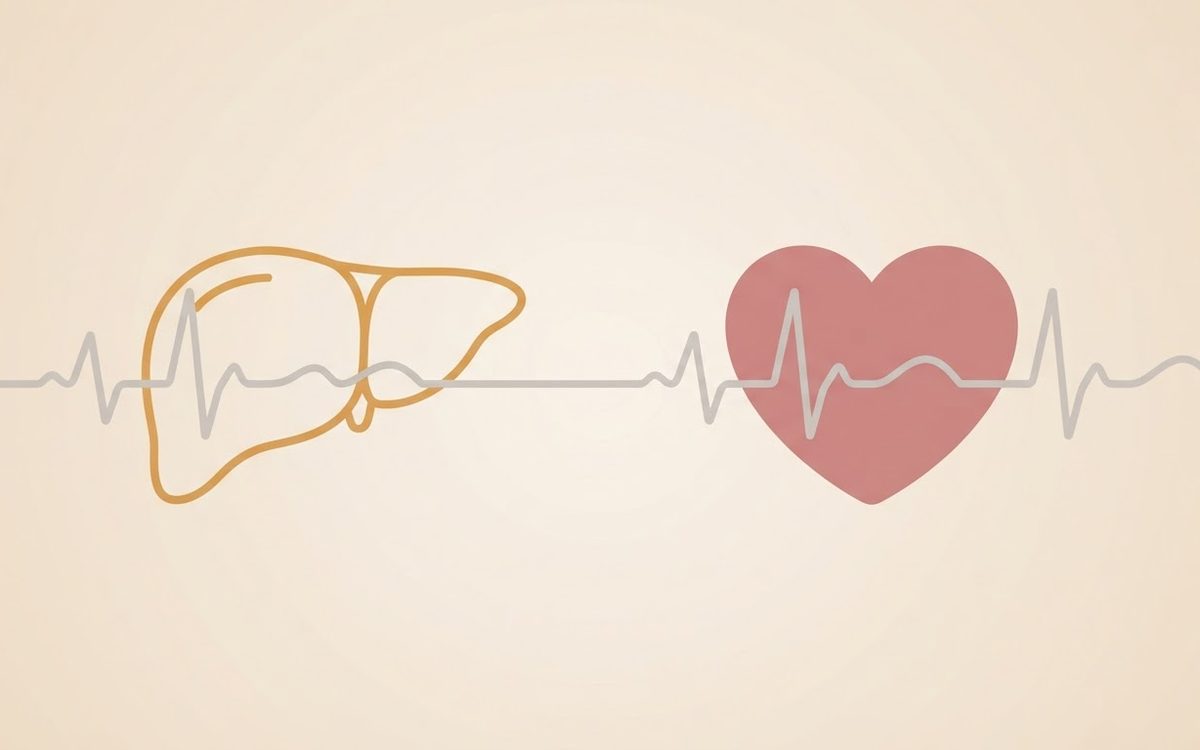
Metabolic Dysfunction-Associated Steatotic Liver Disease (MASLD) and Risk of Atrial Fibrillation Recurrence After Catheter Ablation: Systematic Review and Met
A systematic review and random-effects meta-analysis showed MASLD and higher liver fibrosis risk are significantly associated with atrial fibrillation (AF) recurrence after catheter ablation, but this does not imply causation; further studies are needed to clarify clinical significance. [1]
How to read this research digest
- What this is
- A digest written by Beyond CKD from the public PubMed abstract, with our own context and reminders from a patient’s perspective. It is not the full paper and not treatment advice.
- Reading the numbers
- Relative risks (RR/HR) with 95% confidence intervals describe the difference between groups and its uncertainty; an interval crossing 1 usually means no significant difference. Meta-analyses pool several trials; a single trial needs replication. If the study population differs from you (e.g. non-diabetic, on dialysis, post-transplant), results may not apply.
- Limits
- Unless a “verification scope” note says the full text was checked, the digest is based on the abstract. We are not physicians and give no individual advice. Conclusions may change with later research.
- Next step
- Take your questions to your care team to ask whether this applies to you, or read the original source: PubMed PMID 42859539
Compiled by a kidney-transplant recipient with a health-management background, from public sources; not physician-reviewed. Our editorial principles
المحتويات
A systematic review and random-effects meta-analysis showed MASLD and higher liver fibrosis risk are significantly associated with atrial fibrillation (AF) recurrence after catheter ablation, but this does not imply causation; further studies are needed to clarify clinical significance. [1]
Study type: Journal Article, Systematic Review (classification: clinical guideline / high-quality systematic review) Published: Reviews in cardiovascular medicine, 2026-09-18 Source: PubMed public abstract
A systematic review and random-effects meta-analysis showed MASLD and higher liver fibrosis risk are significantly associated with atrial fibrillation (AF) recurrence after catheter ablation, but this does not imply causation; further studies are needed to clarify clinical significance. [1]
Why this study matters
Why this topic is important
Atrial fibrillation (AF) undergoing catheter ablation (catheter ablation, CA) is a common rhythm-control therapy, but post-procedural recurrence rates remain considerable. Metabolic dysfunction-associated steatotic liver disease (MASLD, formerly sometimes referred to as NAFLD/MAFLD) is part of the cluster of cardiovascular and metabolic risk factors and may affect cardiac structure and electrophysiological substrate. This study performed a systematic review and used a random-effects model to pool observational studies, aiming to assess whether MASLD and stratified fibrosis-risk states are associated with AF recurrence after CA. [1]
What the study actually found
Main findings (based on the abstract)
- The literature search identified 160 records; 7 studies were included for qualitative summary; among these, 6 studies (total 2,921 patients) were included in the primary meta-analysis comparing AF recurrence rates between MASLD and non-MASLD. The MASLD group numbered 894, and the non-MASLD group numbered 2,027.
- Pooled risk ratio (RR) across the 6 studies: MASLD was associated with AF recurrence, RR = 1.77 (95% CI 1.43–2.18; p < 0.001; I2 = 64.1%) [1].
- In a pooled analysis of 5 studies reporting adjusted estimates, MASLD remained significantly associated with recurrence, adjusted hazard ratio (HR) = 2.13 (95% CI 1.49–3.04; p < 0.001; I2 = 70.5%) [1].
- Fibrosis-risk stratified analyses showed: intermediate/high-risk FIB-4 was associated with higher recurrence (RR = 2.03, 95% CI 1.27–3.26; p = 0.003; I2 = 71.3%), and intermediate/high NFS was also associated with higher recurrence (RR = 1.65, 95% CI 1.12–2.43; p = 0.01; I2 = 49.9%) [1].
The above data are taken from the systematic review and meta-analysis abstract report. [1]
Possible implications for patients with CKD, dialysis, or transplant
Interpretation and implications (distinguishing observed associations from unestablished conclusions)
- Observed association: In the pooled observational studies, MASLD and higher liver fibrosis risk were statistically significantly associated with increased AF recurrence after CA. [1]
- Conclusions supported by current evidence: There is a systematic review and meta-analysis supporting that this association exists in observational data, but this represents association, not proof that MASLD causes AF recurrence.
- Unproven hypotheses: Whether improving or treating MASLD / reducing liver fibrosis risk lowers AF recurrence after CA, and the biological mechanisms linking MASLD and AF recurrence, require prospective studies or interventional trials for verification. The current findings cannot be used directly to change clinical management (e.g., ablation technique or medications).
Limitations of the current research
Study limitations (notes on abstract source and methods)
- This article is based on the PubMed public abstract and the full texts were not reviewed, so details of each original study's methods, MASLD diagnostic criteria (imaging, serologic, or other), follow-up durations, confounder control, or case characteristics cannot be examined.
- The original included studies were mostly observational, susceptible to confounding and selection bias; the meta-analyses showed moderate to high heterogeneity (I2 values were elevated in multiple analyses), indicating differences in results and methods across studies.
- The abstract did not provide individual study sample size details, definition differences, or lists of adjusted covariates, so sources of bias or consistency of results could not be fully assessed.
Conclusions that remain uncertain
Uncertain points or areas needing further research
- Whether a direct causal relationship exists: current evidence is observational and shows association, but cannot establish MASLD as a causal factor for AF recurrence.
- Whether intervention is beneficial: there is no evidence yet that treating MASLD or improving liver fibrosis reduces post-CA AF recurrence.
- Applicability to specific populations: the abstract does not state whether chronic kidney disease, dialysis, or transplant patients were included; applicability and risk stratification for this platform's readership (patients with kidney disease) are unclear.
- Optimal fibrosis assessment tools and cutoffs: although FIB-4 and NFS intermediate/high risk were associated with higher recurrence in pooled analyses, how to apply these scores in clinical AF management is not established.
Questions to discuss with your medical team
- I have AF and plan to undergo catheter ablation: should my physician evaluate me for MASLD or liver fibrosis risk? (Discuss with electrophysiologist and hepatology/ liver specialist)
- Does my care team use noninvasive tools such as FIB-4 or NFS to assess liver fibrosis pre- or post-procedure? How would those results affect ablation strategy or follow-up?
- If diagnosed with MASLD, how should I discuss potential cardiovascular and post-procedural risks with my team, and whether further testing or treatment is indicated?
- Given current evidence, would clinicians recommend special preoperative assessment or postoperative follow-up strategies for patients with MASLD? What ongoing or needed studies might provide clearer guidance?
How to read this study (our interpretation)
This section was written by the Beyond CKD editor — a kidney-transplant recipient with a health-management background, not a physician — using only the PubMed abstract. We have not read the full paper, and no clinician has reviewed this text. It is meant to help you understand the numbers, not to advise treatment.
What the study asked
Atrial fibrillation (AF) often comes back after catheter ablation. This meta-analysis asked whether metabolic dysfunction-associated steatotic liver disease (MASLD, formerly non-alcoholic fatty liver) and the liver-fibrosis risk estimated by blood scores such as FIB-4 and NFS are associated with AF recurrence after ablation. It pooled 6 observational studies with 2,921 patients (894 with MASLD, 2,027 without).
How to read the results
People with MASLD had a risk ratio of 1.77 for AF recurrence (95% CI 1.43–2.18) — roughly 1.8 times the risk of those without. In 5 studies that adjusted for other factors, the hazard ratio was 2.13 (1.49–3.04), still clearly significant. Fibrosis scores told a similar story: intermediate/high FIB-4 RR 2.03 (1.27–3.26), intermediate/high NFS RR 1.65 (1.12–2.43). I² between 50% and 70% indicates moderate-to-high heterogeneity, but the direction was consistent. These are associations: people with fatty liver often also have obesity, diabetes and sleep apnoea, which themselves drive recurrence. That the link survived adjustment suggests it is not only those factors — but it does not show that treating the liver prevents recurrence.
Limitations
All studies were observational, so causation cannot be established. Only 6 studies and under 3,000 patients; MASLD may have been diagnosed differently (imaging, scores or biopsy) across studies. The abstract does not report follow-up duration or ablation technique. FIB-4 tends to run high in older people, which limits it as a stand-alone fibrosis marker.
What it means for readers and people with kidney disease
If you have AF and are facing or have had ablation, and you also have fatty liver or metabolic syndrome, this is a reminder that liver-metabolic health may be tied to your rhythm outcome — managing weight, glucose and lipids is not only about the liver. For people with CKD, MASLD and CKD frequently coexist, a textbook case for cross-specialty care. It does not say people with fatty liver should avoid ablation, nor that a liver drug will prevent recurrence.
How to check further
Ask your doctor: Do I have fatty liver? What are my FIB-4 or NFS scores? What concrete weight and metabolic targets should I aim for around ablation?
Original abstract: PubMed 42859539 (https://pubmed.ncbi.nlm.nih.gov/42859539/). Interpretation last updated 2026-11-06.
References
[1] Theofilis P, Karakasis P, Vlachakis PK, Pamporis K, Vordoni A, Oikonomou E. Metabolic Dysfunction-Associated Steatotic Liver Disease and Atrial Fibrillation Recurrence After Catheter Ablation: A Systematic Review and Meta-Analysis.. Reviews in cardiovascular medicine. 2026. DOI: 10.31083/RCM54276. PMID: 42859539.
Medical disclaimer: This article is for general health education and information only. It does not constitute individual medical diagnosis, treatment advice, or a doctor–patient relationship. Medical research is continually updated, and study findings have their own scope and limitations. Every patient's condition, laboratory values, medications and treatment needs differ. Do not stop or adjust medication doses, change your diet or fluid intake, or alter dialysis or transplant treatment based on this article alone. For any medical questions, please consult your nephrologist or another qualified healthcare professional.
Article created: 2026-10-18 | Original study published: 2026-09-18 | Last checked: 2026-10-18 (source metadata has been cross-checked with PubMed)
سجلّ التغييرات
- AdSense 最終複審準備:新增站方判讀段(研究問題/結果解讀/限制/意義/查證),zh/en/ja,依 PubMed 摘要撰寫
Where to go next
Related knowledge

EASL‑EASD‑EASO Guidance: resmetirom and semaglutide Recommended Use in MASH
This summary compiles the 2026 joint guidance, describing when to consider resmetirom or semaglutide, how to choose between them, and key monitoring points in non-cirrhotic MASH with…
Fatty Liver Is More Than "Fat in the Liver": The MASLD Rename, How to Calculate FIB-4, Who Needs Fibrosis Testing, and How Much Weight Loss Works
About 1 in 3 adults worldwide has fatty liver; in Taiwan and Japan prevalence is around 30%. Since 2023 it is called MASLD.
查核:「脂肪肝沒什麼大不了,反正也沒藥醫」是真的嗎?
兩句都不對。脂肪肝(現稱 MASLD)影響全球約 30% 成人,少數會進展到肝纖維化、肝硬化與肝癌,也是心血管疾病與慢性腎臟病的獨立危險因子;減重 7–10% 可讓多數人的肝脂肪與發炎改善,2024 年美國 FDA 核准了第一個針對 MASH 肝纖維化的藥物 resmetirom。本文整理證據、限制與腎友的關聯。
Related global data
الكبد والجهاز الهضمي · إحصاءات عالمية عن انتشار الأمراضGlobal burden and trends for this topic (with sources and years)Lived experience

After Rebirth: From Dialysis Patient to Health Educator — Choosing to Return to the Ward
Shock at birth led to chronic glomerulonephritis; dialysis began at 26; a kidney transplant came on Christmas Day at 32.

Why Did I End Up on Dialysis?
A difficult birth, shock and oxygen deprivation damaged both my kidneys. As a teenager I skipped my medication. At 26, a single glass of orange juice sent me straight to the emergency room.
